As politics and culture both become more polarized, it becomes increasingly important to control the narrative. More and more, politicians, content creators, and other public figures have stressed the importance of optics, a pervasive buzzword that refers to how the public perceives of an event or course of action. This idea reveals the importance of narrative, specifically those who control the narrative. As Bijan pointed out in class on Tuesday, the incident between the Covington Catholic students, the Black Israelites, and Native American veteran Nathan Phillips reveals the importance of controlling the narrative. The initial narrative, most notably among members of the progressive Left, was that the boys from Covington Catholic, mainly Nick Sandmann, were mocking Phillips while wearing MAGA hats and therefore were the clear villains in the situation. However, the narrative then shifted when conservative commentators took umbrage with this narrative and revealed footage that showed the boys were responding to taunting from a small group of Black Israelites, which they claimed complicated the initial narrative. This racially-charged incident soon became a rallying point for both the right and the left, with some supporting the students and condemning Philips and others taking the opposite position. At the same time, centrists chastised both sides for taking these extreme positions, noting that the narrative was ultimately complicated and that only those directly involved would ever know the true story.
Currently, members of the GOP are struggling to take control of the narrative surrounding the government shutdown that lasted 35 days and only recently ended, as in this tweet from Senator Ted Cruz:
Meanwhile, Democrat messaging has consistently laid the blame for the shutdown at the feet of President Donald Trump, who back in December of 2018 stated that he would be proud to shutdown the government over funding for his proposed border wall. Both Republicans and Democrats are attempting to take control of the narrative surrounding the shutdown, an incident that results from actions that could be considered a form of protest; Democrats are protesting Trump’s wall and Republicans are protesting what they perceive as the unchecked migration of undocumented immigrants (or, in their terms, illegal aliens, another case of trying to take control of the narrative). Ultimately, both factions are attempting to control the optics of the situation and make themselves look good in the eyes of their base.
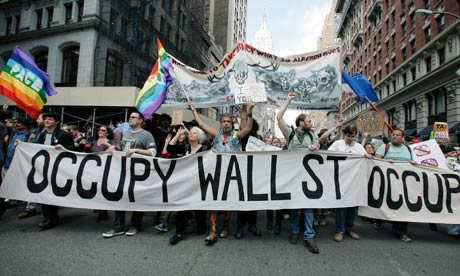
In terms of protest movements, the need to control the narrative becomes most prominent in the tension between the Occupy Movement, which sought to raise issues surrounding income inequality, and the so-called One Percent, the wealthy few who want to maintain the existing status quo. Mainstream news media (which is overwhelmingly controlled by the corporate entities owned by the One Percent) often dismissed the Occupy Movement by framing them as having no clear objective, ignoring the messaging about advancing social and economic justice and new forms of democracy. In this way, the One Percent were able to take control of the narrative surrounding the issue of income inequality. Yet the ideas espoused by the Occupy Movement took root among voters who increasingly called on their elected officials to not just address income inequality but do something about it as well. This then forced the news media to address the issue as well, demonstrating both the importance of controlling the narrative and just how quickly that control can change hands (thus highlighting Michel Foucault’s ideas regarding how power is diffused and embodied in things like discourse and knowledge).
Ultimately, narrativizing political views and cultural ideologies helps to embed them in the popular consciousness, but those who control the narrative can influence how those ideas manifest. Issues such as income inequality, gender identity, racial relationships, queerness, and more all benefit from being narrativized, as this allows them to be understood by people who do not belong to the groups impacted by these issues. At the same time, though, these narratives can be co-opted by people who wish to suppress or oppress marginalized groups (as seen in the rhetoric used by Donald Trump during the run-up to the 2016 presidential election). Thus, those who control the narrative can impact society in various ways, but that control can (and frequently does) shift and change hands often.
 English 876-Protest Movements and Art