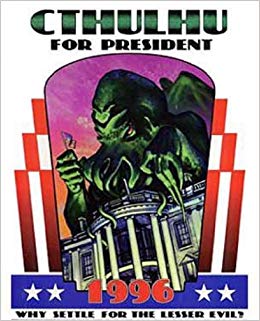
Up front, I should state that this post is going to be a little light on theory but heavy on self-reflection and application (it might also ramble a bit because I have a lot of thoughts on this week’s topic). I find the concepts of tactical performance and electoral guerrilla theater (EGT) fascinating, because I feel like both have sort of diffused into popular culture and the mainstream consciousness in various ways, especially since the rise of the Internet throughout the late-20th and early-21st centuries. While I was unfamiliar with the case studies presented in L.M Bogad’s book Electoral Guerrilla Theater, I was somewhat familiar with the tactics he described throughout because of how they have become appropriated by popular culture. For instance, in my younger years, I often played the Call of Cthulhu role-playing game published by Chaosium, Inc., who, in 1996, launched the “Cthulhu for President” campaign. Their slogan: “Why settle for the lesser evil?” As a radical progressive Generation X-er somewhat disillusioned by a political process that often seemed little more than a choice between two undesirable people, this message resonated deeply with me.
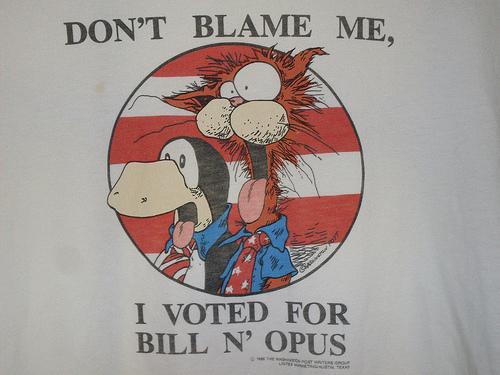
Similarly, I can recall when, in 1984 and then again in 1988, Bloom County creator Berkeley Breathed embarked on a long-running story in which Bill the Cat won the National Radical Meadow Party’s nomination to run for President of the United States alongside his running mate, Opus the Penguin. Though this story line occurred in a daily newspaper comic strip, it eventually had real world implications, with people wearing tee-shirts that announced “Don’t blame me…I voted for Bill ‘n’ Opus.”
And while I was too young to experience it first hand, I am aware that in 1976 the Marvel Comics character Howard the Duck (created by writer Steve Gerber) ran for president. Like Bill the Cat’s presidential aspirations, this mock candidacy evolved out of story published in the Howard the Duck comics, but then Marvel announced that the character was indeed running for president. However, his candidacy was more of a joke and a way for the company to sell more merchandise than an actual attempt to win high office. Nevertheless, Marvel impresario Stan Lee claimed that “Howard’s in-comic and real world campaigning earned him thousands of real-world write-in votes,” though there is no proof of that actually happening.
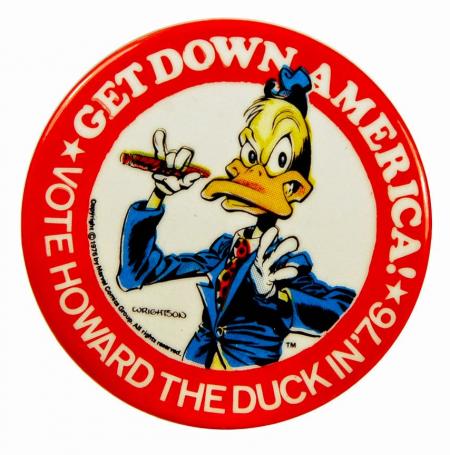
While these campaigns are not exactly the same as those discussed by Bogad or the performance tactics practiced by Augosto Boal in his “Theatre of the Oppressed,” they nevertheless utilize similar strategies that help reveal the silliness and exclusionary nature of the actual electoral process. The operate in a similar way to “corrode and rejuvenate different elements of the civic body” (Bogad 17) while also highlighting the fact that elections often denies entry to marginalized or disenfranchised groups via rhetoric that emphasizes dignity and elitism. The mock campaigns listed above similarly aim to destabilize and reveal the performative aspects of actual electoral campaigns, in much the same way that the films of John Waters sought to destabilize the norms of conventional heterosexual society and decency (NOTE: as a film scholar, I often relate things through the lens of cinema). With films like Pink Flamingos (1972) and Female Trouble (1974), Waters aimed to “to challenge mainstream sensibilities and push the boundaries of tastefulness” (Olson 166) while also helping to usher queer culture into the mainstream.
As much as I hate to repeat myself, I feel like this week’s topic once again relates to Foucault’s ideas regarding the diffusion of power within society. In the cast of EGT, the electoral guerrilla performers are actively attempting to shift the balance of electoral power in favor of marginalized groups, particularly in the case of queer performers like Joan JettBlakk (who sought to destabilize the electoral ritual while also highlighting the plight of queer people and people of color) and Paula Pantsdown (who acted on behalf of Australia’s marginalized Asian community). Such acts of defiance demonstrate how power resides in the hands of a wealthy elite, but that power can suddenly diffuse into the hands of disenfranchised individuals through rebellious performative acts.
Of course, it must be noted that conservatives and those in power can also utilize these same tactics to shore up their own power. For instance, Right-wing provocateur James O’Keefe of Project Veritas utilized tactical performance to successfully (though only temporarily) defund the Association of Community Organizations for Reform Now (ACORN). Other conservative figures such as Christopher Cantwell, Milo Yiannopoulos, Ben Shapiro, and Richard Spencer all use performative tactics to spread conservative and ultra-right-wing ideologies. Even President Donald Trump utilizes such tactics through his rallies and his Twitter feed. Ultimately, tactical performance can help reveal the struggles faced by marginalized groups or individuals, but it can also be used to maintain existing power structures. This idea takes on even more resonance in the hypermediated 21st century, when any act of performance holds the potential to go viral and radically alter a political narrative.
Works cited
Bogad, L.M. Electoral Guerrilla Theatre: Radical Ridicule and Social Movements. Routledge, 2005.
Olson, Christopher J. 100 Greatest Cult Films. Rowman & Littlefield, 2018.